A friend passed this on. She says the BBC believes the average person will only have read 6 books from this list. At least 6 of these I had to read for school. It is definitely a British list but there are several important books on it.
1 Pride and Prejudice - Jane Austen
2 The Lord of the Rings X
3 Jane Eyre - Charlotte Bronte
4 Harry Potter series
5 To Kill a Mockingbird – X
6 The Bible - X (though I may have skimmed the begats)
7 Wuthering Heights - Emily Bronte
8 Nineteen Eighty Four - George Orwell X+
9 His Dark Materials - Philip Pullman
10 Great Expectations - Charles Dickens
11 Little Women - Louisa M Alcott X
12 Tess of the D’Urbervilles - Thomas Hardy
13 Catch 22 - Joseph Heller (started but didn't finish)
14 Complete Works of Shakespeare - hahahaha! About 5 or 6 of them
15 Rebecca - Daphne Du Maurier X
16 The Hobbit - JRR Tolkien X+
17 Birdsong - Sebastian Faulks
18 Catcher in the Rye - JD Salinger - X
19 The Time Traveller’s Wife - Audrey Niffenegger
20 Middlemarch - George Eliot
21 Gone With The Wind - Margaret Mitchell
22 The Great Gatsby - F Scott Fitzgerald X
23 Bleak House - Charles Dickens
24 War and Peace - Leo Tolstoy
25 The Hitch Hiker’s Guide to the Galaxy - Douglas Adams - X+
26 Brideshead Revisited - Evelyn Waugh
27 Crime and Punishment - Fyodor Dostoyevsky
28 Grapes of Wrath - John Steinbeck X
29 Alice in Wonderland - Lewis Carroll – X+
30 The Wind in the Willows - Kenneth Grahame X
31 Anna Karenina - Leo Tolstoy -
32 David Copperfield - Charles Dickens
33 Chronicles of Narnia - CS Lewis X
34 Emma - Jane Austen
35 Persuasion - Jane Austen
36 The Lion, The Witch and The Wardrobe - CS Lewis – X+
37 The Kite Runner - Khaled Hosseini – X
38 Captain Corelli’s Mandolin - Louis De Bernieres
39 Memoirs of a Geisha - Arthur Golden
40 Winnie the Pooh - AA Milne – X+
41 Animal Farm - George Orwell X
42 The Da Vinci Code - Dan Brown -
43 One Hundred Years of Solitude - Gabriel Garcia Marquez
44 A Prayer for Owen Meaney - John Irving
45 The Woman in White - Wilkie Collins
46 Anne of Green Gables - LM Montgomery - X+
47 Far From The Madding Crowd - Thomas Hardy
48 The Handmaid’s Tale - Margaret Atwood -X
49 Lord of the Flies - William Golding X
50 Atonement - Ian McEwan X
51 Life of Pi - Yann Martel X+
52 Dune - Frank Herbert
53 Cold Comfort Farm - Stella Gibbons
54 Sense and Sensibility - Jane Austen
55 A Suitable Boy - Vikram Seth
56 The Shadow of the Wind - Carlos Ruiz Zafon
57 A Tale Of Two Cities - Charles Dickens
58 Brave New World - Aldous Huxley X
59 The Curious Incident of the Dog in the Night-time - Mark Haddon
60 Love In The Time Of Cholera - Gabriel Garcia Marquez
61 Of Mice and Men - John Steinbeck - X
62 Lolita - Vladimir Nabokov
63 The Secret History - Donna Tartt
64 The Lovely Bones - Alice Sebold
65 Count of Monte Cristo - Alexandre Dumas
66 On The Road - Jack Kerouac -
67 Jude the Obscure - Thomas Hardy
68 Bridget Jones’s Diary - Helen Fielding -
69 Midnight’s Children - Salman Rushdie
70 Moby Dick - Herman Melville -
71 Oliver Twist - Charles Dickens -
72 Dracula - Bram Stoker
73 The Secret Garden - Frances Hodgson Burnett - X+
74 Notes From A Small Island - Bill Bryson
75 Ulysses - James Joyce - (I tried, oh how I tried!)
76 The Bell Jar - Sylvia Plath
77 Swallows and Amazons - Arthur Ransome
78 Germinal - Emile Zola - (I tried this one in French but didn't finish)
79 Vanity Fair - William Makepeace Thackeray
80 Possession - AS Byatt
81 A Christmas Carol - Charles Dickens
82 Cloud Atlas - David Mitchell
83 The Color Purple - Alice Walker
84 The Remains of the Day - Kazuo Ishiguro
85 Madame Bovary - Gustave Flaubert
86 A Fine Balance - Rohinton Mistry
87 Charlotte’s Web - EB White - X
88 The Five People You Meet In Heaven - Mitch Albom
89 Adventures of Sherlock Holmes - Sir Arthur Conan Doyle - X (I think so)
90 The Faraway Tree Collection - Enid Blyton
91 Heart of Darkness - Joseph Conrad
92 The Little Prince - Antoine De Saint-Exupery X
93 The Wasp Factory - Iain Banks
94 Watership Down - Richard Adams
95 A Confederacy of Dunces - John Kennedy Toole
96 A Town Like Alice - Nevil Shute
97 The Three Musketeers - Alexandre Dumas
98 Hamlet - William Shakespeare - X
99 Charlie and the Chocolate Factory - Roald Dahl - X
100 Les Miserables - Victor Hugo
Read - 31
Loved - 9
Recent reads that I really enjoyed:
Eva Hoffman - Lost in Translation
Heather O'Neill - Lullabies for Little Criminals
Milan Kundera - The Unbearable Lightness of Being
Sara Gruen - Water for Elephants
Currently reading (both nonfiction):
Tony Horwitz - Confederates in the Attic
Ronald Wright - Stolen Continents
On my reading shelf just waiting for me to get to them:
Isabel Allende - Eva Luna
Marie Phillips - Gods Behaving Badly
Dionne Brand - What we all Long For
Alexandra Fuller - Don't Let's Go to the Dogs Tonight
Chimamanda Ngozi Adichie - Purple Hibiscus
Anyone else have any good reads to suggest?
To participate, say on Facebook, copy and paste into your own notes then delete my comments add your own and tag the friends you want to share this with.
Instructions:
1) Look at the list and put an 'x' after those you have read.
2) Add a '+' to the ones you LOVE.
3) Star '*' those you plan on reading.
4) Tally your total at the bottom.
5) Tag your friends including the person whose list you saw!
Showing posts with label books. Show all posts
Showing posts with label books. Show all posts
Friday, February 27, 2009


Saturday, September 06, 2008
History Lesson: Mugabe and Zimbabwe
In 1957, Ghana became the first European colony in Africa south of the Sahara to gain its political independence. Kwame Nkrumah, Ghana’s new prime minister, invited young Africans from countries still under colonial rule to move to Ghana and help build the new country; a young schoolteacher from Rhodesia, Robert Mugabe, was among them.
In 1960, during a visit home to his mother, Mugabe was invited to join a march protesting the arrest of two nationalist leaders in the Rhodesian capital, Salisbury. Facing police, the marchers stopped to hold an impromptu political rally. Somehow Mugabe found himself hoisted onto the improvised stage alongside other leaders like Joshua Nkomo, who headed the leading black opposition group, the National Democratic Party. Mugabe gave a rousing speech (“The nationalist movement will only succeed if it is based on a blending of all classes of men”) and the nationalist leaders convinced him to remain in Rhodesia and become publicity secretary of the NDP, which soon morphed into the Zimbabwe African People’s Union (ZAPU). Three years later, Mugabe engineered a split within ZAPU to form the Zimbabwe African National Union. He would dominate the country’s politics from that moment on.
Nothing about Mugabe’s earlier life portended his swift rise, the South African journalist Heidi Holland notes in her “psychobiography” Dinner with Mugabe. Born in 1924 in Kutama, in the central part of the country, Mugabe was a shy, precocious child. When Robert was 10 years old, his father, a carpenter, moved away to start a second family and broke off all contact. Mugabe’s mother clung devotedly to the Catholic Church and to Robert. She told him he was marked for greatness and sent him for a Jesuit education (Mugabe is still a devoted Catholic.) Mugabe would go on to study in South Africa at the University of Fort Hare, the alma mater of Nelson Mandela and other nationalist leaders. He started teaching after graduation, and soon made his way to Ghana.The Rhodesia that Mugabe returned to in 1960 was a tense, violent country, especially for its black population. The former British colony was governed by a small, tightly-knit and mainly English-speaking white settler population who had been granted “self-rule” by the British at the expense of the country’s black majority. Whites had first arrived in Zimbabwe in the 19th century as part of an aggressive British colonial expansion north from South Africa in search of natural resources. The new arrivals, through a mixture of force and cunning, eventually dispossessed the locals of their land. In 1896 blacks rose up in what would come to be known as the “First Chimurenga”, or liberation war. Though they fought valiantly, they lost and colonisation was formalised. By the 1950s, nearly 80 per cent of the best agricultural land belonged to whites. Most blacks were condemned to life on rural reserves, burdened by heavy taxes that forced men to work on commercial farms and mines or move to the ghettos of Salisbury or Rhodesia’s second city, Bulawayo, in search of wage-work. The country’s whites gradually developed a distinctive political identity and a reputation for unbending racism and prejudice.
In a 1960 speech in Cape Town the British prime minister Harold Macmillan told South Africa’s white rulers that “the wind of change is blowing through this continent, and whether we like it or not, this growth of national consciousness is a political fact. We must all accept it as a fact, and our national policies must take account of it.” The South Africans rejected Macmillan’s advice, digging in for another three decades of undemocratic rule. Five years later the Rhodesian prime minister Ian Smith announced a “Unilateral Declaration of Independence” from Britain, vowing that blacks would not govern Rhodesia “in a thousand years.”
By this point Mugabe’s new movement, ZANU, had grown into the main opposition force, largely due to its exploitation of ethnic differences. ZANU was dominated by the majority Shona; Nkomo’s ZAPU became associated with the minority Ndebele. In 1964, Mugabe was arrested, and he spent 10 years in prison before he was released as part of an agreement between the Rhodesian government and ZANU guerrillas, by now engaged in a full-scale civil war. Mugabe’s only son died (at age three) during his prison term, and Smith refused to allow him to attend the funeral; in Holland’s account, these slights had a lasting effect on Mugabe.Holland first met Mugabe in 1975 in Salisbury, where she worked as magazine editor. She arranged for a lawyer friend to meet Mugabe secretly at her suburban home. Over dinner Mugabe said little, but impressed Holland nonetheless: driving Mugabe to the train station after the meeting (his ride had failed to materialise), Holland left her small son asleep alone in the house. The next day, Mugabe called to check that the child was OK.
Over the next 30 years Holland had no further contact with Mugabe, who went on to lead a brutal guerrilla war that would eventually exhaust the government and the appetite of white Rhodesians for segregation at all costs. In the late 1970s, the regime – stripped of British support and abandoned by South Africa’s Apartheid rulers (and their backers in the US Republican Party) – initiated negotiations with the black opposition.
But the war also bred elements of the political culture that independent Zimbabwe would later inherit: the use of violence to settle political scores and to obliterate opponents, disregard for human rights, slavish reverence for authority, ideological rigidness and corruption.
ZANU won a majority in the first democratic elections in 1980, and Mugabe was initially conciliatory to whites, guaranteeing them seats in the new Parliament (one went to Smith) and appointing a white man as agriculture minister. But barely two years into independence – under the pretext of fighting an attempted coup by guerrillas loyal to Nkomo, who had become the opposition leader – Mugabe unleashed a murderous, North Korean-trained army unit in the ZAPU-dominated Matabeleland province, indiscriminately killing civilians and guerrillas alike.
A report by the Catholic Bishops conference later estimated the total number of murdered or disappeared at more than 20,000 people. But Mugabe achieved his political aim: in 1987 he coerced a weak Nkomo into accepting a “Unity Accord”, effectively swallowing ZAPU into the new ZANU-Patriotic Front. Not long thereafter, Mugabe changed the constitution to make himself executive president.One of the legacies of that time – and a testament of the power of the nationalist narrative that African independence leaders embodied – is that few if any of Mugabe’s present Western critics publicly denounced these murders. Instead he received a knighthood from Queen Elizabeth II in 1994 and honorary degrees from American universities. The economy was growing steadily even in the hostile shadow of Apartheid South Africa and access to education and health services markedly improved. As Lord Corrington, the British foreign secretary during independence negotiations, tells Holland: “But other than the killing of the Ndebele, it went tolerably well under Mugabe at first, didn’t it? He wasn’t running a fascist state. He didn’t appear to be a bad dictator.”
In 1995, street riots erupted in the capital against rising prices and unemployment. A mineworker, Morgan Tsvangirai, who would emerge as Mugabe’s most formidable opponent, led the newly formed Zimbabwe Congress of Trade Unions. Academics, human rights activists and lawyers would later join the trade unions to form the Movement for Democratic Change (MDC). Their main political focus, alongside protesting economic hardship, was reforming the country’s constitution. Mugabe pushed back by announcing a referendum in 2000 to increase his powers and extend his tenure as president. Much to his surprise, the referendum failed, and he was clearly stung by the result.
With parliamentary elections looming and an opposition buoyed by the referendum, ZANU-PF unleashed what Mugabe termed the “Third Chimurenga”. (The guerrilla war against the Rhodesian government had been the second.) This involved an effort at land redistribution; the British were blamed for abandoning promises to fund the acquisition of private commercial farms to distribute to black farmers. Whites, who still owned much of the productive land and who had reluctantly come to accept independence, also provided easy targets.
Squatters identified as “war veterans” (among them were 18-year-olds who could not have fought in the guerrilla war that ended before they were born) soon invaded white farms. But it became clear that redistribution was in the eye of the beholder: the best farms were parcelled out to Mugabe’s cabinet ministers and senior army officers.
A few whites were brutally attacked, and their plight predictably became front-page news in the West. In the British Parliament, members spoke once again of “the people of Rhodesia”. Peter Godwin, a white journalist born in Zimbabwe, later claimed that being white in post-independence Zimbabwe was “starting to feel a bit like being a Jew in Poland in 1939.” What was not apparent at first was that – just like in Smith’s Rhodesia – the bulk of the victims were black: members of the opposition were murdered, tortured or imprisoned. Journalists were harassed, newspaper offices closed or bombed and people denied food if they failed to join ZANU.
In 2002 Mugabe was re-elected to another six year term in an election marred by fraud and violence, and condemned as deeply flawed by both Zimbabwean and foreign observers. Since then Zimbabwe’s economy has crashed – there is large-scale poverty and the currency is essentially worthless. Thousands have fled to neighbouring South Africa (whose president, Thabo Mbeki, remains a loyal ally of Mugabe, though his party and the South African trade union movement have backed the Zimbabwean opposition.)
During this period, Mugabe and his closest aides became more delusional and their government took on a siege mentality. Holland’s account of Mugabe’s political career is book ended with an account of her second meeting with Mugabe in 2007. She describes a banner in his office proclaiming “Mugabe is Right” and his insistence that Zimbabwe’s economy is a “hundred times better than the average African economy.”
On March 29 of this year, Zimbabweans went to the polls again in presidential elections. The opposition was again subjected to intimidation and violence by ZANU paramilitaries; Morgan Tsvangirai was viciously assaulted by police. However, as the first results arrived, it appeared Tsvangirai held a clear lead. The next day the electoral commission, stuffed with government sympathizers, announced that it would delay the results. A month later, following announcements from the army and police that they would not serve an MDC government, a final result was announced: Tsvangirai had won, but not by enough. So an unprecedented second round was scheduled, and intimidation and attacks on opposition candidates and supporters increased. Days before the vote Tsvangirai – citing high levels of violence – withdrew, guaranteeing Mugabe a hollow victory.
Southern African governments belatedly stepped in, forcing Mugabe to meet with Tsvangirai to thrash out the details of a unity government. The best scenario under the circumstances is for Mugabe to retain a ceremonial presidential post while Tsvangirai serves as prime minister with a fair representation of MDC leaders in key cabinet posts. But who occupies State House is not only the issue to resolve.
Larger questions remain about Mugabe’s legacy – and Zimbabwe’s future. Mugabe turned the security and civil services into affiliates of the ruling party, rigged elections, encouraged paramilitaries and stifled public debate. Under the cover of Third-Worldism he also mocked real political grievances – as varied as land hunger and unequal global relations – to forward his own selfish, violent agenda. In the West, he became an example of a supposedly black and specifically African, political pathology. But those critics must now come to terms with the fact that his regime is not an aberration, as Holland depicts it: it is also a by-product of Zimbabwe’s violent colonial and white minority past and the duplicity of the post-Cold War world.
Mugabe’s Zimbabwe demonstrates, among other things, that nationalism as a political ideology is fundamentally flawed, despite its role in the successful struggle for independence. The MDC clearly presents a rupture with the predatory regimes of both Smith and Mugabe, and it bodes well that the MDC was forged as a non-violent post-independence movement. But it remains to be seen whether it can carve its own path between neoliberalism (as its boosters in the West want) and appeals from its constituents inside Zimbabwe for more substantive democracy, including a solution to the land question. But first there’s the small matter of consigning Mugabe to history.
Sean Jacobs teaches African Studies and Media Studies at the University of Michigan in Ann Arbor. He was born in South Africa.


Friday, August 08, 2008
The Inside and Outside of Bodies and Transgression of Boundaries
I'm reading a really interesting book right now by Robyn Longhurst, called Bodies: Exploring Fluid Boundaries. She is attempting to embody geography, to bring material bodies into academic discourse, and she makes some very interesting points. So I thought I would like to share a few cool quotes.
 First, on "managerial bodies in public space", she writes:
It made me wonder, why are we disgusted and/or embarrassed and/or frightened by the transgression of things on the inside of our bodies appearing on the outside? For instance, blood:
But of course, women leak red. This transgression of bodily boundaries relates also to pregnant women in public places. She says:
 This reminded me of a recent public lactation "incident", which you can read about here:
The comments are interesting. Aside from mostly supportive comments, there are the usual reactions to "women's issues", from disagreement ("I think this is getting to the point of ridiculous. Of course breastfeeding is natural. But I don't think its too much to ask to cover up while doing it.") to dismissive ("Lighten up folks, lighten up! There are so many far more serious issues that all of us, including nursing moms, need to focus our time and energies on that this issue pales by comparison.")
 First, on "managerial bodies in public space", she writes:
I argue, first, that highly tailored, dark-coloured (often black, dark grey or navy) business suits function to seal the bodies of (men and women) managers. Firm, straight lines and starched creases give the appearance of a body that is impervious to outside penetration. They also give the appearance of a body that is impervious to the dangers and threats of matter from inside the body making its way to the outside. It is considered inappropriate for matter to make its way from the inside to the outside of bodies (for example, farting, burping, urinating, spitting, dribbling, sneezing, coughing, having a ‘runny nose’, crying, and sweating) in most inner city workplaces. This suited, professional, respectable body, however, can never be guaranteed. Like all bodies it is continually monitored and disciplined but inevitably proves itself to be insecure.
It made me wonder, why are we disgusted and/or embarrassed and/or frightened by the transgression of things on the inside of our bodies appearing on the outside? For instance, blood:
An advertisement for sanitary napkins (pads)... showed blue liquid being poured on and seeping into the pad. The aim seemed to be to demonstrate the pad's absorbency... Although the pad is designed to absorb menstrual blood (various shades of red) the advertisers choose to use a blue liquid to illustrate the product's absorbency capacity.
[...]
If advertisers were to use red fluid to represent blood they might invoke in viewers and potential customers feelings of dirtiness, disgust and even death that would dissuade them from purchasing the product. Clear blue liquid, on the other hand, is often associated with purity and cleanliness. There are potential links with running water, the colossal cleaning capacity of the ocean, blue granules in cleaning products and laundry powers, and blue rinses (both for clothes and for (often wealthy) elderly women’s greying hair). It is also inevitable that a connection may be made with the term ‘blue blood’. Blue blood refers tothat which flows in the veins of old and aristocratic families … who claimed never to have been contaminated by Moorish, Jewish, or other foreign admixture; the expression probably originated in the blueness of the veins of the people of fair complexion as compared with those of dark skin.(Compact Oxford English Dictionary 1991:147)
On all accounts blue blood seems to be preferred over and above red blood.
But of course, women leak red. This transgression of bodily boundaries relates also to pregnant women in public places. She says:
When pregnant women occupy the public spaces (of Rational Man) they are often represented as ‘matter out of place’ (Douglas 1966:35). Women are often thought to threaten and disrupt a social system that requires them to remain largely confined to private space during pregnancy. Pregnant women can be seen to occupy a borderline state that disturbs identity, system and order by not respecting borders, positions and rules. The pregnant body, it is thought, threatens to expel matter from inside – to seep and leak. The pregnant woman may vomit (morning sickness), cry (she is constructed as ‘overly’ emotional), need to urinate more frequently, produce colostrum which may leak from her breasts, have a ‘show’ appear, have her ‘waters break’, and sweat with the effort of carrying the extra weight of her body. Even more than these leakages, she ‘threatens’ to split her one self into two – another human being is about to cross the boundary of the ‘eroticised orifice’ – the vagina (Grosz 1990:88). The pregnant body is neither subject nor object but rather exemplifies the impossible, ambiguous and untenable identity of each. Consequently, the pregnant body is often constructed as abject. It is a body that is considered dangerous and to be feared. It is also considered to be a body that needs to be controlled.
There are many ways in which attempts are made to control pregnant bodies. First, the fetus is often treated as though it were a public concern. Pregnant women’s rights to bodily autonomy are considered to be questionable. Second, this leads to pregnant women’s stomachs being subject to public gaze and often touch. Their ‘bodily space’ is frequently invaded. Third, pregnant women tend to be constructed by lovers, husbands, partners, friends, family, strangers, health workers and themselves as being in a ‘condition’ in which they must take special care in order to protect the well-being of the fetus. Fourth, pregnant women are subject to dietary regimes in an attempt to control what enters their bodies.
 This reminded me of a recent public lactation "incident", which you can read about here:
 Dozens of nursing mothers crowded into a downtown Vancouver H&M clothing store over the lunch hour on Thursday to protest the way the chain treated a breastfeeding mother last weekend.
Manuela Valle said three store employees told her last week that H&M policy did not allow her to nurse her eight-week-old baby in the store because it might offend other customers, and ushered her to a backroom.
Breastfeeding advocates reacted by organizing a protest — dubbed a "nurse-in" — at the store on Thursday.
The comments are interesting. Aside from mostly supportive comments, there are the usual reactions to "women's issues", from disagreement ("I think this is getting to the point of ridiculous. Of course breastfeeding is natural. But I don't think its too much to ask to cover up while doing it.") to dismissive ("Lighten up folks, lighten up! There are so many far more serious issues that all of us, including nursing moms, need to focus our time and energies on that this issue pales by comparison.")
Tuesday, July 08, 2008
The latest from our crazy world
Did you know the "latest data and research" shows:
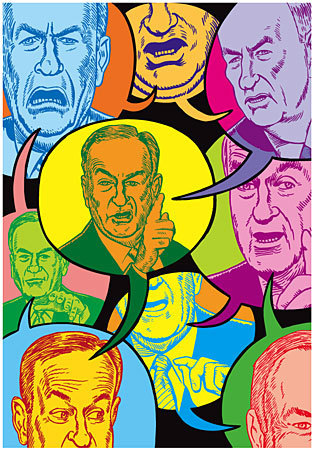 Speaking of valuing honesty and whining less, Bill O'Reilly has defended Fox's photoshopping of reporters to make them look subtly (or not so subtly) more menacing. Since The Times has previously run caricatures and illustrations of him (like the one on the right), O'Reilly calls this "the most hypocritical situation we have ever seen." Apparently he can't see the difference between what is clearly an illustration and (in Matt Bors' words) "to manipulate photographs of enemies, make them look ugly and pass them off as real on a 'news' show".
Price of gas got you down? Forget choosing a more efficient vehicle, lobbying for improved public transportation, or driving less. Just... pray. And if that doesn't work, just say "please sir, can we have some more" to Saudi Arabia. From Carfree USA:

And finally, via Wired, a human-like race is going extinct
* Liberals are more self-centered than conservatives.It's true. Or at least, it is according to Peter Schweizer's generously titled Makers and Takers: Why conservatives work harder, feel happier, have closer families, take fewer drugs, give more generously, value honesty more, are less materialistic and envious, whine less … and even hug their children more than liberals
* Conservatives are more generous and charitable than liberals.
* Liberals are more envious and less hardworking than conservatives.
* Conservatives value truth more than liberals, and are less prone to cheating and lying.
* Liberals are more angry than conservatives.
* Conservatives are actually more knowledgeable than liberals.
* Liberals are more dissatisfied and unhappy than conservatives.
Speaking of valuing honesty and whining less, Bill O'Reilly has defended Fox's photoshopping of reporters to make them look subtly (or not so subtly) more menacing. Since The Times has previously run caricatures and illustrations of him (like the one on the right), O'Reilly calls this "the most hypocritical situation we have ever seen." Apparently he can't see the difference between what is clearly an illustration and (in Matt Bors' words) "to manipulate photographs of enemies, make them look ugly and pass them off as real on a 'news' show".Price of gas got you down? Forget choosing a more efficient vehicle, lobbying for improved public transportation, or driving less. Just... pray. And if that doesn't work, just say "please sir, can we have some more" to Saudi Arabia. From Carfree USA:
The Pray at the Pump Movement, founded by Rocky Twyman, has been holding prayer vigils at gas stations across the country. On Monday, Twyman decided to take his movement from Exxon and Shell stations straight to the steps of the Embassy of Saudi Arabia in Washington, D.C., hoping to encourage the oil-rich country to raise the amount of barrels they release each day from 200,000 to 1.2 million.

And finally, via Wired, a human-like race is going extinct
Orangutan numbers have declined sharply on the only two islands where they still live in the wild and they could become the first great ape species to go extinct if urgent action isn't taken, a new study says.Of course, animal rights activists, rescue workers and scientists who work tirelessly to prevent such a tragedy probably just whine too much and don't hug their kids enough.
Saturday, March 22, 2008
Random Thoughts on Race, Crime, and Human Resilience
I'm currently working on a project on memory and South African exiles. I was reading Lewis Nkosi's Home and Exile and other Selections when I came across a passage that sat with me. It's in the essay "Apartheid: A Daily Exercise in the Absurd". After describing some of the odd, horrible and certainly absurd things that went on in Apartheid South Africa (like the court wrangling over such questions as at what point does a kiss become passionate enough to convict someone of interracial sex) he wrote:

It made me think about people who, say, visit the West Bank and see people smiling and even dancing and think - wow, this isn't so bad. People make the best of things. They don't sit around waiting for someone to come rescue them - they form formal organizations, they practice everyday forms of resistance, and they find ways to live as happy an existence as possible. Sometimes they live for the moment, focusing on the present, concerned little with a future that looks only bleak.
He continues:
When people are put in conditions that anticipate their criminality it is indeed a monumental effort that is required to avoid that very thing. I'm thinking about crime among minority populations, like in the black ghettos in the US for instance. Now consider in this context Bill O'Reilly's remarks after Hurricane Katrina:
One could go on, of course, recounting the morbid aspects of apartheid, but it all sounds so hopelessly melodramatic that the total effect is to undermine people's credulity. Sometimes, people wonder after reading about these conditions how the Africans are able to survive at all. One Englishman who attended a first night of a Johannesburg opera was surprised to find well-dressed Africans who looked reasonably happy, mingling with the white audience. From that he concluded that the stories he had read about South Africa were grossly exaggerated. To my own mind that was the highest tribute anybody cold pay to the indestructibility of the human spirit, the ability to absorb hurt and injury and still maintain a semblance of human dignity.

It made me think about people who, say, visit the West Bank and see people smiling and even dancing and think - wow, this isn't so bad. People make the best of things. They don't sit around waiting for someone to come rescue them - they form formal organizations, they practice everyday forms of resistance, and they find ways to live as happy an existence as possible. Sometimes they live for the moment, focusing on the present, concerned little with a future that looks only bleak.
He continues:
Africans have learned that if they are to remain sane at all it is pointless to live within the law. In a country where the government has legislated against sex, drinks, employment, free movement and many other things, which are taken for granted in the Western world, it would take a monumental kind of patience to keep up with the demands of the law.
[...]
They know every time a policeman encounters a black man in the street he assumes a crime has been committed; so why bother to live a legal life?
When people are put in conditions that anticipate their criminality it is indeed a monumental effort that is required to avoid that very thing. I'm thinking about crime among minority populations, like in the black ghettos in the US for instance. Now consider in this context Bill O'Reilly's remarks after Hurricane Katrina:
Every American kid should be required to watch videotape of the poor in New Orleans and see how they suffered, because they couldn't get out of town. And then, every teacher should tell the students, 'If you refuse to learn, if you refuse to work hard, if you become addicted, if you live a gangsta-life, you will be poor and powerless just like many of those in New Orleans.'
Saturday, September 08, 2007
Madeleine L’Engle, Writer of Children’s Classics, Is Dead at 88
As a confirmed bookworm and serious child-nerd, who frequently found herself in the quandary of no-new-books-to-read, I re-read my favourite books over and over... and over and over. Several of Madeleine L'Engle's books fell into this group of well-loved stories, including of course the famous Wrinkle in Time. Filled with science, magic, space and time, and children coming of age, her books spoke both to my natural curiosity and to my growing emotional complexity.
Madeleine L'Engle, who in writing more than 60 books, including childhood fables, religious meditations and science fiction, weaved emotional tapestries transcending genre and generation, died Thursday in Connecticut. She was 88.
[...]
Her works - poetry, plays, autobiography and books on prayer - were deeply, quixotically personal. But it was in her vivid children's characters that readers most clearly glimpsed her passionate search for the questions that mattered most. She sometimes spoke of her writing as if she were taking dictation from her subconscious.
[...]
The "St. James Guide to Children's Writers" called Ms. L'Engle "one of the truly important writers of juvenile fiction in recent decades." Such accolades did not come from pulling punches: "Wrinkle" is one of the most banned books because of its treatment of the deity.
[...]
The book used concepts that Ms. L'Engle said she had plucked from Einstein's theory of relativity and Planck's quantum theory, almost flaunting her frequent assertion that children's literature is literature too difficult for adults to understand. She also characterized the book as her refutation of ideas of German theologians.
<The New York Times>
Thursday, March 22, 2007
What's Bush Reading Lately? A Photo Essay
Someone Get this Man a Chomsky... Stat! The security of the world depends on it!
Bush's Book List

A History of the English-Speaking Peoples Since 1900 by Andrew Roberts, who "proudly declared himself 'extremely right-wing' in a recent Financial Times interview" and who calls the war on terrorism "the Manichean world-historical struggle" against fascism, including "Totalitarian Islamic Terrorist Fascism".
Roberts believes almost all the advances of freedom in the 20th century have been made by the English-speaking peoples. The Iraq invasion was just another example of English-speaking countries doing what the UN should have done. (read more in this gushing review)

America Alone: The End of the World as We Know It by Mark Steyn, Toronto's favourite racist (although he moved to New Hampshire, no doubt to get away from the scary diversity here, oh and he calls himself a "culturist" not a racist). In his spare time Steyn keeps himself busy preparing for the upcoming Muslim takeover of the world.

Supreme Command: Soldiers, Statesmen, and Leadership in Wartime by Eliot A. Cohen, which "argued that the greatest civilian wartime leaders, notably Abraham Lincoln and Churchill, had a far better strategic sense than their generals"

Imperial Grunts: The American Military on the Ground by Robert D. Kaplan, who thinks the world is one big Western, and the US military is operating is trying to civilize "injun country".
And let's not forget The Stranger by Camus, "a classic novel about a westerner that kills an Arab for no good reason and dies with no remorse" as summarized by Jon Stewart.

I'm sure we can all agree, we'd prefer if he the leader of the free world got back to basics:


A History of the English-Speaking Peoples Since 1900 by Andrew Roberts, who "proudly declared himself 'extremely right-wing' in a recent Financial Times interview" and who calls the war on terrorism "the Manichean world-historical struggle" against fascism, including "Totalitarian Islamic Terrorist Fascism".
Roberts believes almost all the advances of freedom in the 20th century have been made by the English-speaking peoples. The Iraq invasion was just another example of English-speaking countries doing what the UN should have done. (read more in this gushing review)

America Alone: The End of the World as We Know It by Mark Steyn, Toronto's favourite racist (although he moved to New Hampshire, no doubt to get away from the scary diversity here, oh and he calls himself a "culturist" not a racist). In his spare time Steyn keeps himself busy preparing for the upcoming Muslim takeover of the world.

Supreme Command: Soldiers, Statesmen, and Leadership in Wartime by Eliot A. Cohen, which "argued that the greatest civilian wartime leaders, notably Abraham Lincoln and Churchill, had a far better strategic sense than their generals"

Imperial Grunts: The American Military on the Ground by Robert D. Kaplan, who thinks the world is one big Western, and the US military is operating is trying to civilize "injun country".
In one way or another, each affirms core neo-conservative ideas: the essential beneficence of U.S. (and Anglospheric) power even if the "natives" are ungrateful; the supreme importance of both "will" and military might in wielding that power, particularly against enemies that can never be "appeased" or "contained" and that, in Roberts' words, are motivated not so much by legitimate grievances against U.S. policies, as by "loathing of the English-speaking people's traditions of democratic pluralism"; the evils of "liberalism", "secularism" and "moral relativism" of western societies that undermine their will to fight; and the catastrophic consequences of retreat or defeat.
All of these also play to Bush's own Manicheanism and self-image as a courageous, often lonely, leader in the mold of a Lincoln or Churchill, determined to pursue what he believes is right regardless of what "old Europe", "intellectuals", "elites", or even the electorate thinks about his course and confident only in the conviction that History or God will vindicate him.
And let's not forget The Stranger by Camus, "a classic novel about a westerner that kills an Arab for no good reason and dies with no remorse" as summarized by Jon Stewart.

I'm sure we can all agree, we'd prefer if he the leader of the free world got back to basics:

Tuesday, March 20, 2007
Validating the Suffering of the Palestinians
 Susan Nathan explores how to address the suffering of the Palestinians without pointlessly resorting to comparisons of whose suffering is worse. Showing how the Palestinians are suffering validates the Palestinian experience, but it in no way reduces the horrors experienced by Jews in the Holocaust.
 It asks for all people to open their hearts, and recognize the common quality to all such human tragedies.
The apparent inability of Jews in Israel and the Diaspora to address the true roots of the Middle East conflict and accept their role in the Palestinians' suffering is given an alibi by their fears, which are in turn stoked by stories in the media of the ever-present threat of anti-Semitism, a Jew-hatred in both Europe and the Arab world that, we are warned, has troubling echoes of the period before the Second World War. A disproportionate part of the media coverage of anti-Semitism concentrates on tarring critics of Israel with this unpleasant label. Anyone who has disturbing things to say about what Israel is doing the the Palestinians is, on this interpretation, an anti-Semite. I have little doubt that the motivation of Israel's defenders in many cases is to silence the critics, whether their criticisms are justified or not.
My own critique of Israel - that it is a state that promotes a profoundly racist view of Arabs and enforces a system of land apartheid between the two populations - risks being treated in the same manner. So how does one reach other Jews and avoid the charge of anti-Semitism? Given the sensitivities of Jews after their history of persecution, I think it helps it we distinguish between making a comparison and drawing a parallel. What do I mean? A comparison is essentially a tool for making quantitative judgments: my suffering is greater or lesser than yours, or the same. Jews have a tendency to demand exclusive rights to certain comparisons, such as that nothing can be worse than the Holocaust, because it involved the attempt to kill a whole people on an unprecedented scale. Anyone who challenges that exclusive right, for example by suggesting that Israel is trying to ethnically cleanse the Palestinians from their homeland, is therefore dismissed as an anti-Semite. The debate immediately gets sidetracked into the question of whether the argument is anti-Semitic rather than whether it is justified.
Drawing a parallel works slightly differently. It refuses, rightly, to make lazy comparisons. Israel is neither Nazi Germany nor apartheid South Africa. It is unique. Instead, a parallel suggests that people can find themselves in similar circumstances, or that one set of events can echo another. Even more important, the emotions people feel in these circumstances may share some of the same quality. That common quality is what allows us to see their suffering as relevant and deserving of recognition, without dragging us into a debate about whose suffering is greater.
From The Other Side of Israel: My Journey Across the Jewish/Arab Divide, written by Susan Nathan. Emphasis mine.
Friday, February 23, 2007
On Fear
 I just finished reading Barry Glassner's The Culture of Fear. Why Americans are Afraid of the Wrong Things: Crime, Drugs, Minorities, Teen Moms, Killer Kids, Mutant Microbes, Plane Crashes, Road Rage, & so much more. It's a good read, although being published in 1999 it is now sort of out of date. After all, fear has seen quite an upswing since 2001.
 Basically he runs through all of those fears listed above and debunks them one by one. He makes pretty good arguments overall, and I tend to agree with him. I find him a bit patronizing, though. He quickly dismisses people's fears because the causes so often do not merit the reactions. But although the reasons for fear might often be irrational, the emotion is very real. A book which I think treated people's fears with more respect is False Alarm: The Truth About the Epidemic of Fear by Marc Siegel.
Ze Frank shows how trying to curing fear with facts can backfire.
Friday, January 13, 2006
Squatter City
Robert Neuwirth is the author of Shadow Cities: A Billion Squatters, A New Urban World., a book examining some of the great squatter neighbourhoods in the world. He lived for two years in these communities, and experienced the vibrancy of these cities within cities. He believes squatters will shape cities in the future.
Listen to an interesting interview with him.
Also check out Down to This: Squalor and Splendour in a Big-City Shantytown by Shaughnessy Bishop-Stall, who spent a year in Toronto's famous Tent City. A great read. Highly recommended!
Topics: Books, Poverty
Listen to an interesting interview with him.
Also check out Down to This: Squalor and Splendour in a Big-City Shantytown by Shaughnessy Bishop-Stall, who spent a year in Toronto's famous Tent City. A great read. Highly recommended!
Topics: Books, Poverty
Hilarious Excerpt from EVERYTHING IS ILLUMINATED by Jonathan Safran Foer
Found on Bookreporter.com: "I had performed recklessly well in my second year of English at university. This was a very majestic thing I did because my instructor was having shit between his brains. Mother was so proud of me, she said, 'Alexi-stop-spleening-me! You have made me so proud of you.' I inquired her to purchase me leather pants, but she said no. 'Shorts?' 'No.' " Read the rest of the excerpt.
Wednesday, November 23, 2005
Carfree Cities (Book Review)
Carfree Cities by Joel Crawford is an excellent book imagining the city without the automobile.
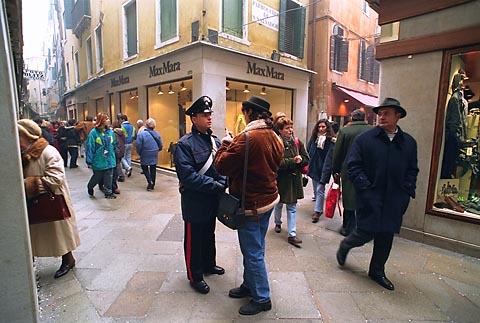
He starts out by expounding on the problem: why cars in cities are bad. He covers environmental, social, and aesthetic problems, as well as an analysis of the danger of cars. He contrasts automobile-dependent cities such as Los Angeles with pedestrian cities such as Venice. The sprawling automotive cities offer a lack of safety (large number of traffic deaths & injury), incredible levels of environmental pollution, a weak social community, and an ugly landscape.
 Then he offers a theoretical solution with a reference design for a carfree city. His suggested topology incorporates a large amount of public space and green space with moderately dense development.
The city is based around small, pedestrian districts connected to each other by a rail-based metro (subway) or tram (streetcar) system. His public transportation system is cheaper and faster than car transportation, and at least as convenient and comfortable (even suggesting first class luxury train cars). He also offers a detailed solution to freight transportation, using standardized shipping containers.
The last portion of the book offers some more practical suggestions for transforming existing cities, creating new ones, and variations, such as a bicycle-based city.
You can order the book, join the discussion on Yahoo Groups, and get more information at Carfree.com.
Topic: Environment - Urban Issues, Book Reviews
He starts out by expounding on the problem: why cars in cities are bad. He covers environmental, social, and aesthetic problems, as well as an analysis of the danger of cars. He contrasts automobile-dependent cities such as Los Angeles with pedestrian cities such as Venice. The sprawling automotive cities offer a lack of safety (large number of traffic deaths & injury), incredible levels of environmental pollution, a weak social community, and an ugly landscape.
Then he offers a theoretical solution with a reference design for a carfree city. His suggested topology incorporates a large amount of public space and green space with moderately dense development. The city is based around small, pedestrian districts connected to each other by a rail-based metro (subway) or tram (streetcar) system. His public transportation system is cheaper and faster than car transportation, and at least as convenient and comfortable (even suggesting first class luxury train cars). He also offers a detailed solution to freight transportation, using standardized shipping containers.
The last portion of the book offers some more practical suggestions for transforming existing cities, creating new ones, and variations, such as a bicycle-based city.
You can order the book, join the discussion on Yahoo Groups, and get more information at Carfree.com.
Topic: Environment - Urban Issues, Book Reviews
Monday, April 04, 2005
Review: Confessions of an Economic Hit Man - John Perkins
This book is at once an autobiography, a 20th century history of America and a call to action. These elements are balanced very well with a very readable narrative style.
The history covered in this book is admittedly controversial. It primarily covers the less-shiny aspects of history, which I doubt are taught in US schools, but which are easily accessible if one only looks. It is also quite well-documented and supported by evidence. Perkins discusses American corporate and governmental involvement with Saudi Arabia, Indonesia, Nicaragua, Panama, Ecuador and many other nations from a first hand perspective.
What is interesting is that we see this history as the setting for a very personal story, through the eyes of a participant. As the title suggests, it is in fact a confession. Perkins was an important player in some of the darker aspects of subtle non-governmental foreign policy, and he is not an apologist.
He shows a little bit of the psychology of people who commit evil acts on behalf of organizations to which they belong. For example, structures set up to do harm can generally find people with the right personality characteristics to be capitalized upon - greed, ambition, etc. What this means is, rather than simply provoking hate towards individuals who are perpetuating exploitation, Perkins reveals the underlying broader issues, such as the consequences of the misuse of power and profit. I think he very effectively places the specifics of historical facts (as well as his story) in context in a way that historical texts typically do not.
Although it is not a prescriptive book as such, Perkins does offer some ideas and suggestions at the end as to what individuals can do if they believe in trying to ameliorate the situation he has presented.
I found it to be both a compelling page turner and very factual at the same time. Highly recommended for the history buff, social activist, avid biography reader, news junkie, or really anyone who cares about the world we live in.
The history covered in this book is admittedly controversial. It primarily covers the less-shiny aspects of history, which I doubt are taught in US schools, but which are easily accessible if one only looks. It is also quite well-documented and supported by evidence. Perkins discusses American corporate and governmental involvement with Saudi Arabia, Indonesia, Nicaragua, Panama, Ecuador and many other nations from a first hand perspective.
What is interesting is that we see this history as the setting for a very personal story, through the eyes of a participant. As the title suggests, it is in fact a confession. Perkins was an important player in some of the darker aspects of subtle non-governmental foreign policy, and he is not an apologist.
He shows a little bit of the psychology of people who commit evil acts on behalf of organizations to which they belong. For example, structures set up to do harm can generally find people with the right personality characteristics to be capitalized upon - greed, ambition, etc. What this means is, rather than simply provoking hate towards individuals who are perpetuating exploitation, Perkins reveals the underlying broader issues, such as the consequences of the misuse of power and profit. I think he very effectively places the specifics of historical facts (as well as his story) in context in a way that historical texts typically do not.
Although it is not a prescriptive book as such, Perkins does offer some ideas and suggestions at the end as to what individuals can do if they believe in trying to ameliorate the situation he has presented.
I found it to be both a compelling page turner and very factual at the same time. Highly recommended for the history buff, social activist, avid biography reader, news junkie, or really anyone who cares about the world we live in.
Tuesday, March 29, 2005
Review: Otherwise Than Being - Emmanuel Levinas
My review on an unnamed online bookstore of Otherwise Than Being: Or Beyond Essence by Emmanuel Levinas
Levinas' best work, but not easy to understand
Much though I am fascinated with Levinas, I do find it nearly unreadable. His text is so dense, it requires (but definitely merits) slow reading.
Although it might be helpful to have read earlier Levinas, this book takes a bit of a departure from the philosophy he espoused in his younger days. I don't believe it is such a radical departure so much as a reorientation and increased sophistication, but that's a topic for another discussion!
I highly recommend this read if you are familiar with phenomenology, particulary Husserl and Heidegger, and Kant. I believe they are essential to understanding his arguments.
If you are willing to put in the time and mental effort to unpack this, it is a very rewarding book. For some additional explanation, a good companion is Beyond by Peperzak.
Levinas' best work, but not easy to understand
Much though I am fascinated with Levinas, I do find it nearly unreadable. His text is so dense, it requires (but definitely merits) slow reading.
Although it might be helpful to have read earlier Levinas, this book takes a bit of a departure from the philosophy he espoused in his younger days. I don't believe it is such a radical departure so much as a reorientation and increased sophistication, but that's a topic for another discussion!
I highly recommend this read if you are familiar with phenomenology, particulary Husserl and Heidegger, and Kant. I believe they are essential to understanding his arguments.
If you are willing to put in the time and mental effort to unpack this, it is a very rewarding book. For some additional explanation, a good companion is Beyond by Peperzak.
Subscribe to:
Posts (Atom)